Accurate measurement | Fast response | Stable and reliable
Stiffness Tester
About Us
Bending Resistance Test
In modern paper and packaging production, the bending resistance test is critical for evaluating the stiffness, flexibility, and durability of paper and paperboard. By determining the bending moment required to deflect a specimen, manufacturers can ensure their products meet strict quality standards and functional requirements.
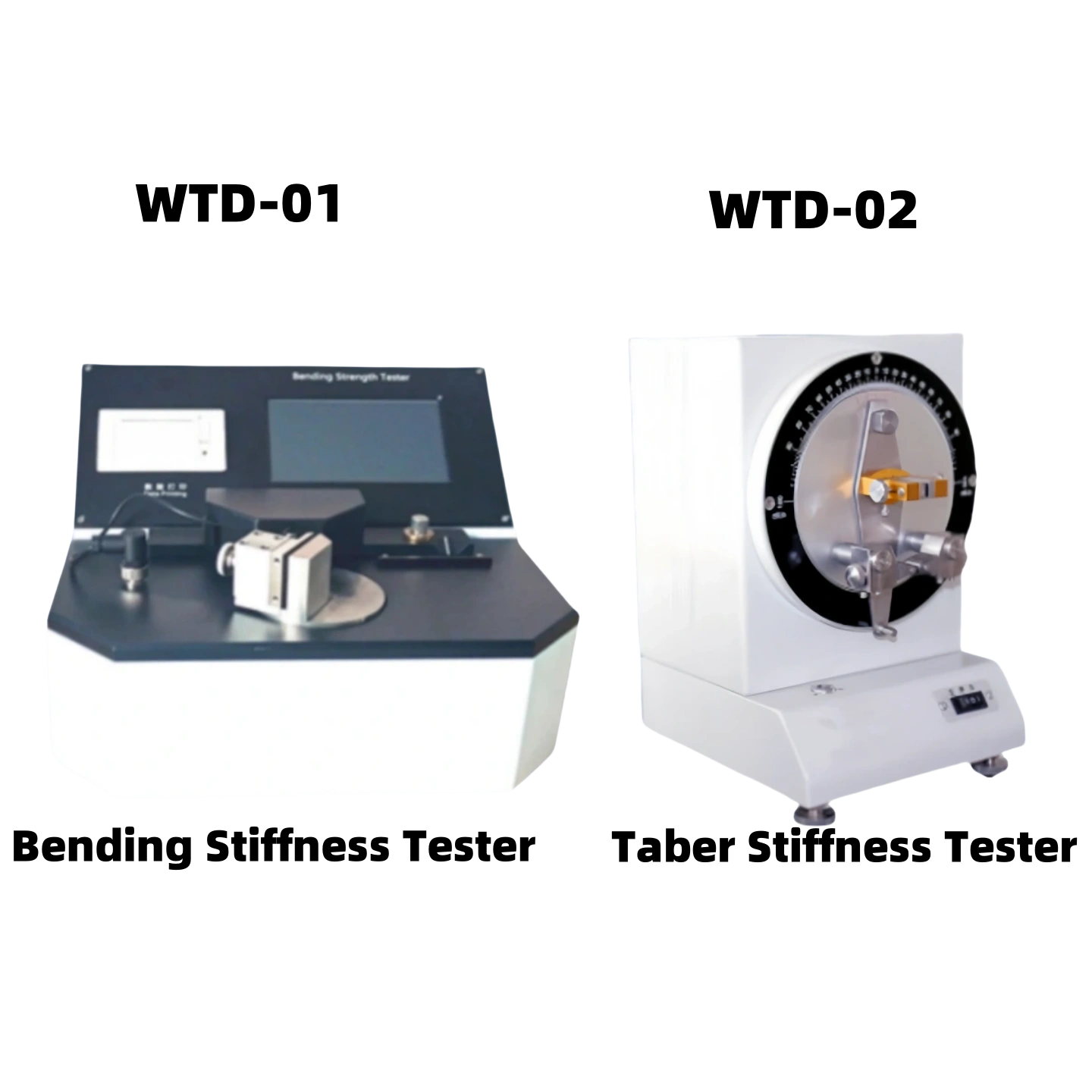
ISO 2493-1 Method: Stiffness Testing Paper Stiffness Tester
The bending resistance test is standardized under ISO 2493-1, which defines how to measure the bending properties of paper and board. A sample is clamped vertically, and the bending moment is recorded as the sample is deflected through a specified angle. For thick or rigid boards, the half bending angle can be used to prevent permanent deformation while still obtaining accurate stiffness data.
This method provides manufacturers with reliable, repeatable results that can be used for product comparison, quality assurance, and production optimization.
Principles of Bending Resistance Testing
The core principle of the bending resistance test is the measurement of bending moment when a specimen is deflected. Key considerations include:
- Proper alignment of the sample to the central axis of the testing device.
- Correct clamping pressure to hold the sample securely without compressing it.
- Adjustment of the driving arm rollers to lightly contact the sample and avoid additional restraint.
By following these principles, laboratories can achieve consistent results suitable for both research and industrial quality control purposes.
Lorem ipsum dolor sit amet, consectetur adipiscing elit. Ut elit tellus, luctus nec ullamcorper mattis, pulvinar dapibus leo.
Applications of Bending Resistance Testing
The bending resistance test is widely used in multiple industries, including:
Packaging:
Evaluating carton strength to prevent deformation during handling.
Quality inspection agencies:
Providing standardized testing for manufacturers and suppliers.
Printing papers:
Ensuring appropriate stiffness for consistent print quality.
Specialty papers:
Testing decorative, security, or technical paper applications.
The test enables manufacturers to optimize material performance, reduce production waste, and improve overall customer satisfaction.
Factors Affecting Bending Resistance
Understanding factors influencing bending resistance helps improve testing accuracy:
- Material thickness and grammage: Heavier papers typically show higher bending moments.
- Moisture content: Paper moisture levels can alter stiffness and flexibility.
- Clamping pressure and alignment: Improper setup can lead to inconsistent readings.
- Temperature and environmental conditions: Extreme temperatures may affect the bending behavior of some boards.
By controlling these variables, manufacturers can ensure reliable, repeatable test results.
Why Bending Resistance Testing Matters
Accurate measurement of bending resistance is essential to:
- Maintain product consistency and performance standards.
- Optimize material selection for packaging, printing, and specialty applications.
- Reduce failures, customer complaints, and production waste.
- Comply with international standards such as ISO 2493-1.
Failing to measure bending resistance accurately can lead to compromised material quality and higher operational costs.
stiffness testing machine
Recommended WTD Series for Bending Resistance Testing
For precise bending resistance testing of paper and paperboard, the Cell Instruments WTD series offers reliable, high-precision solutions tailored to different testing needs. Both WTD-01 and WTD-02 are designed for ISO-compliant stiffness measurement, yet they cater to slightly different applications depending on sample size, bending angle flexibility, and testing range.
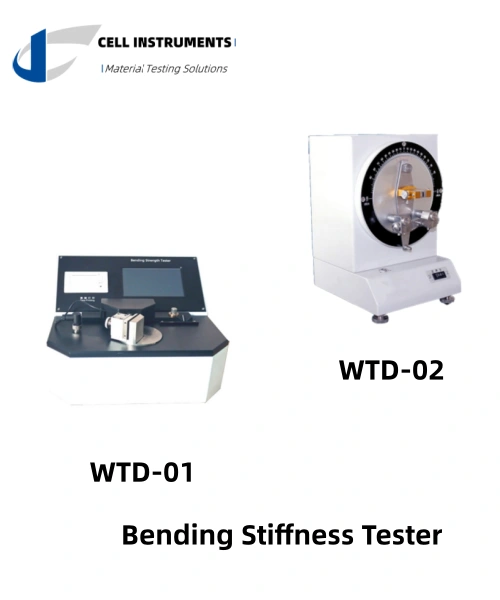
The WTD-01 is ideal for laboratories requiring advanced measurement capabilities, including multi-angle testing and high-resolution bending control. The WTD-02 is suitable for standard quality control procedures with simpler setups, offering efficiency and accuracy for routine production environments.
Below is a detailed comparison of the two models:
| Feature | WTD-01 | WTD-02 |
|---|---|---|
| Sample Size | 38×80 mm | 38×70 mm |
| Testing Range | 0~10000 mN | 1~500 mN·m (7 ranges) |
| Bending Angle | Adjustable 1–92° | 15° ±0.3°, 7.5° ±0.3° |
| Angular Speed Control | 0.5–50°/sec | (200° ±20°)/min |
| Span Range | 1~60 mm (adjustable, 8 grates) | Fixed 50 mm ±0.1 mm |
| Sensor / Indication Accuracy | ±0.1% | ±2% |
| Sample Grip | Manual clamp, automatic reset, non-destructive | Standard clamp |
| Printer | Thermal printer | – |
Key Takeaways:
- WTD-01 is ideal for advanced labs requiring multi-angle measurement and precise bending control across a wide force range.
- WTD-02 is optimized for standard QC, with simpler operation, fixed bending angle, and reliable routine testing.
Selecting the appropriate WTD model ensures accurate bending resistance testing, improving paper and board quality while complying with ISO 2493-1 standards.
Why Choose Cell Instruments?
As a leading manufacturer of materials testing instruments, Cell Instruments combines decades of experience with precision engineering. Key advantages include:
- Proven reliability: Instruments built to deliver accurate, repeatable results.
- Industry expertise: Deep understanding of paper, packaging, and specialty board testing.
- Custom solutions: Tailored setups for unique material types or testing requirements.
- Global support: Comprehensive training, service, and documentation for international clients.
Choosing Cell Instruments ensures not only access to high-quality equipment but also expert guidance for optimizing bending resistance testing workflows.
Frequently Asked Questions about Bending Resistance Test
What is a bending resistance test, and why is it important?
A1: It can test from standard printing paper (e.g., 80g/m²) to corrugated board (0.3mm–1.5mm). Custom clamps are available for special thickness requirements.
Can bending resistance tests help in material selection and product development?
Yes. By assessing stiffness and flexibility, manufacturers can choose materials that optimize durability and performance in packaging, printing, or industrial applications. The test also helps in adjusting manufacturing parameters to achieve desired mechanical properties.
Is the WTD-01 suitable for research and production environments?
Absolutely. The WTD-01 is designed for both R&D laboratories and production quality control, offering fast, reliable, and repeatable testing. It helps teams identify material weaknesses early, reducing waste and ensuring product quality.
 EN
EN  AR
AR  BG
BG  CS
CS  DA
DA  DE
DE  EL
EL  ES
ES  ET
ET  FI
FI  FR
FR  HU
HU  ID
ID  IT
IT  JA
JA  KO
KO  LT
LT  LV
LV  NB
NB  NL
NL  PL
PL  PT
PT  RO
RO  RU
RU  SK
SK  SL
SL  SV
SV  TR
TR  UK
UK